As I’ve mentioned before, I originally learned the Rider-Waite tarot. I was actually lucky enough at the tender age of 14 to have found the Rider Waite book, the original one printed in 1910, The Key To The Tarot by Arthur Edward Waite – the one who designed it.
I was immediately enchanted by this volume and ‘borrowed’ it indefinitely from my uncle Paul to set about learning and studying it. Finding this tome changed my life; The book is still in my possession and I still treasure it.
Of course it was the illustrations of this deck that first drew me in. I’ll wager that’s the case with most Tarot exponents, and in this respect the contribution of artist Pamela Coleman Smith cannot be overestimated.
She created images that are powerful and mysterious, ones that contain all the required imagery and symbolism without being clunky, obvious or over-the-top about it. A good example is her depiction of the final Major trump The World, which shows the dancer figure surrounded by the tetramorph and a closed wreath which makes a circle (signifying the completion of the cycle and handing us back to 0 The Fool who’s number is also circular). But there’s also subtle stuff, like the sash the dancer wears, which is in a shape that evokes it’s own Hebrew letter Tav as well as Aleph, which each of her batons is also supposed to reference. Smith didn’t just create evocative and interesting images; she worked a lot of information into them.
She also made a whole deck. The 78-card tarot comprises a Major 22 card deck and a Minor 56 card one. The minor deck looks a lot like playing cards, with four suits that sequence Ace through to King. And in most decks – definitely the Marseilles and Thoth ones – the only picture you get on a 7 of Wands is of 7 wands, much like the playing cards we use today. For the RWS deck Pamela Coleman Smith (or Pixie as she liked to be called) did some of her best work on the Minor Arcana, and every single card has a mysterious and symbolic illustration on it.
For this reason I learned and used the whole deck in my readings. I knew a lot of readers only used the 22 Major Arcana and I thought it was a waste. I suspected a lot of readers weren’t conversant with the whole deck, even though I knew that for most decks the Minor Arcana wasn’t represented very well or at all.
I started reading professionally in my teens; A lot of my ideas would changed and evolve over decades to come, but I had some strongly-held convictions at the time. One of these is that we should use the full 78-card deck, and anything less is a lazy disservice to the Querent.
Is this how I feel now? Hell, no!
I’m embarrassed by the belligerence of some of the ideas I expressed nearly 40 years ago. That said, I’m not the only one to say it. I just did some Googling and found a range of opinions, many of which are stated in more strident language than I ever used about it. Many feel that reading with the Major Arcana is not “playing with the full deck.”
Any many feel, as I currently do, that the 22 trump Major Arcana sequence is conceptually pretty perfect and not missing much, that using the Minors can “muddy up the water” of a reading by introducing irrelevance and minutiae, and that most decks’s representation of the Minor Arcana is pretty crap and needn’t be bothered with.
If I’ve read for you in the last decade you’ll know I generally use the Minor deck too. The general assumption (which is simplistic but usable) is that Major Cards are big things (massive epiphanies, drastic turnarounds, epic forces at play in your life) while Minor Cards are little things. (gossip, an unexpected bill, a small promotion, an event in your friendship or relationship, etc).
The 22 Major Arcana are about 28% of a 78 card deck, so a ten-card spread like the Celtic Cross where you’re using everything should have about 3 Major cards. If I see 5+ Major Arcana in your Celtic Cross, I’m getting ready to talk about the massive sweeping transformative next chapter of your life. If I see none, we’ll be talking about your mundane day-to-day details.

In this respect, using the Minor Arcana can be good. We don’t always want the big brushes to paint with big bold strokes. When people go for a reading they’re usually interested in little details that their reader should be prepared to examine.
Notably, the Minor Arcana divide up into four main areas of life: Wands (fire signs, expression, creativity, vocation), Cups (water signs, emotion, relationships, spirituality, subconscious), Swords (air signs, intellect, communication, misfortune) and Pentacles (earth signs, physicality, commerce, money, business).
This enables a reader to drill down into different areas of life, but it’s not exactly symmetrical. It’s actually pretty lopsided – with all of the cards represented by air signs and the intellect being bad cards about tragedy, deception, mourning and sorrow. Not exactly balanced, and if I identified astrologically as an air sign I’d be pretty pissed off.
Also, there’s sixteen court carts in the Minor leagues. And what do they mean? Do they represent the Querent? Or someone they know? Or do they represent the principle or matter that’s associated with them? Are they a person or an event? Most readers won’t admit it, but nearly all of them struggle with court cards, and they can be big ambiguous poorly-interpreted blind spots in a lot of readings.
Also, I’m only bringing the Minors in if they’re good. Most decks don’t offer a good Minor Arcana, just a picture of 2 swords to represent the 2 of Swords. Use the full 78 with those decks and two thirds of your spread can look uninspiring and confusing.
I know it’s silly, but Querents expect some imagery. If I just talk to them without cards they’ll feel cheated, or at least that something fundamental is missing from the process. The table between us should have mysterious and evocative imagery to talk about – the power of Tarot, not the banality of playing cards. It should like more like a powerful inner exploration than a game of Bridge or Rummy.
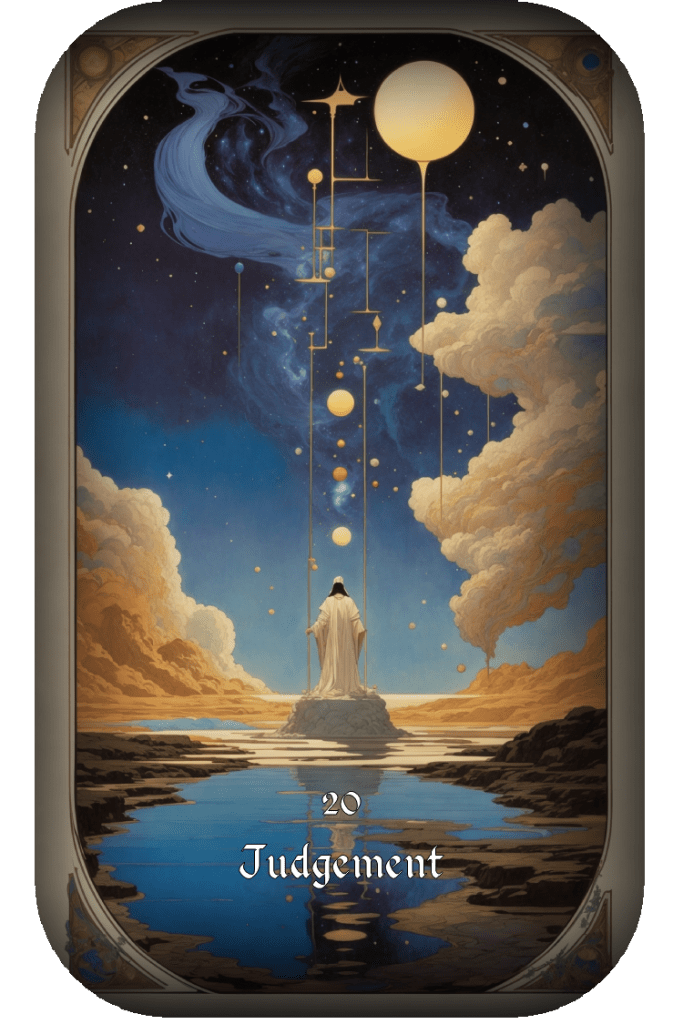
For the Tiny Traveler’s Tarot I made a decision to limit the deck to the Major Arcana. I considered a lot of factors but the biggest one, the one that informed all of my decisions about it, was the philosophy and practical intent of the deck.
I limited it to the 22 card sequence for the same reason I shrunk the cards and splashed out on a fancy metal tin. I want this deck to be portable. I want it to get used, not to languish in the bookshelf of a collector.
That means it’ll be easy to learn, read and memorize. It’ll have the durability and dimensions to take anywhere and to read on most surfaces. If I made the cards bigger you’d need a sizable table to read them on, and if I included 78 of them as well as a book, it won’t fit in your pocket.
It’s also worth mentioning that adding a Minor Arcana is going to triple the cost without adding a proportionate amount of functionality. One day I’ll maybe produce a deck that costs three times as much, meant to stay in your library as a comprehensive reference tool. But this isn’t it.
The Tiny Traveler’s Tarot is designed for focus and optimal usability, and that’s what’s informed my decision to build it around the Major Arcana.


 Copperscene
Leave a reply to Reversals of Fortune (how Modernism got superseded, and what that means for Tarot) – Copperscene Cancel reply