
Design notes. Again, I’m going to explain some of the choices I’ve made in my design of The Tiny Traveler’s Tarot. I prefer to align with the design and structure of the RWS Tarot than the Marseille or Thoth decks, but I felt the need to diverge from some of the Major Arcana depictions in the RWS.
My disclaimer again is I feel that when we create a new deck that we’re not just allowed to reconsider and re-imagine it, but it’s kind of obligatory. I can offer music as an analogy; If you’re going to cover a song that’s already good, it doesn’t need to be replaced and there’s no requirement for a carbon copy of it to exist in the universe. If you’re not contributing a new twist or a different take you’re creating something redundant, and wasting time and space.
This said, my wish for different versions of the classic Arcana was a big part of what inspired me to create this deck. Some of the cards are problematic, to me at least, and therefore the renditions are going to be different in my deck. I’ve explained why my version of Death looks the way it does, and more recently I talked about how I depict The Chariot.
Today, I’ll be discussion why my versions of Strength, The Lovers and The Devil depart from historical depictions. Let’s start with Strength.
Strength’s meanings are strength (duh!), fortitude, resilience, courage, control of your own emotions and resources, as well as other qualities like self-esteem and compassion. This is a pretty reductive take, and I’ve always disliked boiling down the essence of a card to rote keywords, but this is the essence and a card’s optics should communicate something about it’s meaning.

The way Strength is shown visually is pretty consistent between older de Marseille and RWS decks, with the image of a woman wrestling with a lion. Specifically, opening or closing it’s mouth. The Hermetic Order of the Golden Dawn’s members had robust debates about whether the act was opening or closing the lion’s mouth. Tarot nerds like me would think that was somehow deep and significant, though I now feel it’s pretentious and pedantic.
Whichever the case, because the question actually doesn’t matter, the core idea is that the human protagonist is exhibiting strength and mastery by dominating and exercising force (albeit gentle force as some insist) over this creature.
I like lions, so it’s an image and concept I’ve never felt comfortable with and personally find distasteful. I’m not sure human dominance over all the creatures in the world is either gentle or an exemplar of our finest qualities. Also, I think the idea only works at all because we attribute all the attributes of this card to lions.
We assign courage, strength, resilience, mastery and leadership to the “king of the jungle,” and it feels more natural to just use a lion to show strength. We don’t need to show someone beating it. That, to me, feels redundant.
Of course, it has to be an inspiring lion to really communicate this, and I feel that my lion does the job. He shows calm repose but clearly has limitless reserves of fortitude and courage. He is connected to land, sea and air, as well as showing communion with the stars. This lion has nothing to hide, and that integrity is as much a source of his strength as his other attributes.

I don’t think what we can extract from my Strength card would be increased by adding someone to wrestle or tame him. So I reduced it to it’s core, simplified it, and that’s an approach I’ve taken with most of the cards.
One of the innovations in the RWS deck was to decorate all of the trumps with secret symbols. All of the cards have heaps of “easter eggs” which reference minutiae and secrets about the card. I’m all for deeper symbolism and hidden meanings, but these days I’m less enthusiastic about a lot of the pedantry and posturing behind it. Also, so much of it was specific Golden Dawn ritual stuff, which I don’t necessarily agree is the essence of Tarot.
My decision for my deck was to maintain the important symbolism but not to place easter eggs. If a symbol is important, it stays where it can be found. And it should enhance one’s understanding of the trump’s meaning, not obfuscate it with silly occult trivia or points of debate. This deck should deliver strong and clear readings, and secret signals to made-up factoids just don’t help. That’s my approach here, anyway.
So, too, with the Lovers. I elected to make this one pretty straightforward. The lovers is about choice and commitment. Ruled by Gemini, it’s also got a strong component of communication.
The Marseille Tarot emphasized the choice aspect. It depicted a man choosing between two women, a “good” girl and one of questionable virtue, with Cupid hovering overhead signalling which choice would be the correct one. I always found this version a bit on the nose, a kind of condescending asymmetry. I jokingly refer to it as a scene from the very first season of The Bachelor.

The RWS made some dramatic changes to The Lovers, presenting a couple instead. The couple is naked, with an angel – possibly Cupid – presiding over them. The concept here is that they are Adam and Eve in the garden of Eden, and that the choice is a naive one. This is a couple who’ve made choices from innocence and therefore incomplete knowledge.
They are shown later in the RWS as figures in The Devil card, this time bound and in hell, where the knowledge and experience that informs their choice is more complete. I’ll tackle their role in The Devil shortly but first I want to explain why I felt the need to differentiate for my own take on The Lovers.
I didn’t incorporate the Biblical stuff. Devotees of the Thoth tarot school rightly criticize A.E Waite for introducing a bunch of puritanical Christian imagery that historically hasn’t been part of the Tarot and it’s resulted in a deck who’s values haven’t aged particularly well.
Also, and this was a big deal for me, I made sure my lovers are facing each other. Personally, I’m not buying the choice and commitment vibe when the lovers stand side by side not seeing or even acknowledging each other. They look like contestants in another unnamed reality show.

What, apart from the Geminian ‘twins’ implication, says “communication” in the RWS Lovers? What choice and commitment is being made? What does that version actually say, beyond sneaking fundamentalist mythology into the deck?
Nope, mine face each other squarely and look into the other’s eyes when they make their choice and commitment. They do so in the heavens, far above the concerns of the practical and secular world, and under the watchful eye of the universe.
One thing I found regrettable in my take on this card, and it applies equally to all of the cards is a lack of diversity. I acknowledge that my version is every bit as hetero-normative as the others, and I offer my apologies to anyone who takes issue with that. It succumbs to the subtext of binaries and polarities, around which the structure of the Tarot is designed.
Truthfully I’d love to have some way of representing every permutation of lover and lovers pairing, but I just don’t know how to do so without making the scene overcrowded or the protagonists too formless and generic. If there’s something I’ve learned from performing stand up comedy it’s that specific is more effective than general, even if you’re implying or extrapolating to entire populations, generations and categories.
Please know that neither I nor this deck are antithetical to LGBTQ+ communities and that my clumsy attempt at reconciling this are illustrated in my version of The World, where I specifically invoke strong rainbow symbolism to communicate inclusion.

One thing I like about the RWS version, and something I hope I retained, is the unsullied, un-compromised and innocent nature of the commitment. The choice is sincere and therefore not pragmatic. It is the commitment that philosopher Soren Kierkergaard described as becoming a “knight of faith.” Kierkergaard’s leap of faith is precisely minus all traces of rationality and pragmatism, so is therefore more sincere and meaningful.
And yes, the price of reason-free choices is sometimes sub-optimal outcomes, which the Tarot should also acknowledge and discuss. Sometimes in life we must be strategic and self-interested, and sometimes we need to just go with our feelings. Acknowledging which is the right time and circumstance for each is the great challenge of our lives.
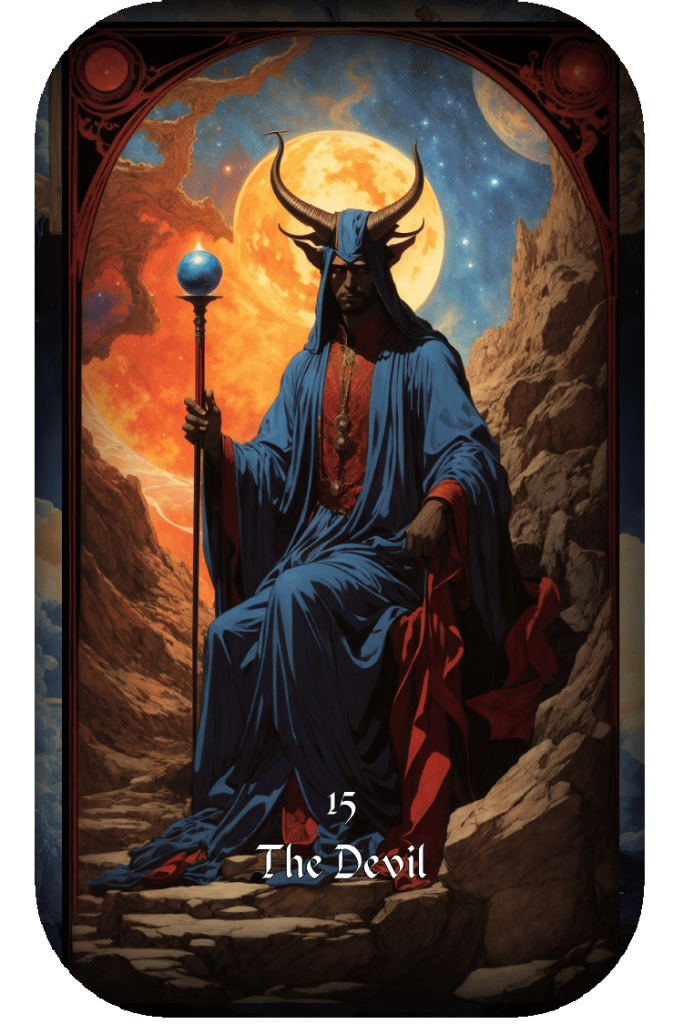
And this brings us around to The Devil. This is another of the Major Arcanes where my version appears to be simpler and less loaded with baggage than it’s predecessors.
I did mention that this card typically features a return of the lovers characters, though only Waite explicitly acknowledges it. This time they are the bound subjects or slaves of a Devil in a pagan scene that tries to offend us. The Marseille Devil highlights the genitalia and pansexuality of this character to demonstrate their utter disregard for conservative ideas of propriety.

Typically, meanings associated with The Devil include bondage, addiction, being trapped, being seduced by the material world and it’s temptations, one’s “shadow self”, feeling that we aren’t in control, and of course our sexuality which can feel wild and unpredictable and not our rational selves. As always, I find these descriptions a little reductive.
The RWS Devil brings back Adam and Eve from The Lovers, bound but significantly with their hands free – so maybe not as trapped as we might assume. This version of The devil also cleverly mirrors The Hierophant (Pope) card and also The Magician, which it parodies.
The RWS Magician’s left hand extends skyward, drawing down inspiration from above, while The Devil’s points down and invokes the Golden Dawn aphorism “As above, so below” implying that it’s not altogether different. His right hand is a parody of the benediction gesture The Hierophant makes with his.
Something I do like about this iteration is the idea that Adam and Eve’s choices now are made with knowledge and experience, are more worldly. If the price of innocent naive choices is that they’re made without understanding of consequence and cost, the price of experience is compromised purity. As we mature and our commitments are made with greater knowledge, the price is how we acquired our jaded understanding.
For my own Devil I stripped away all the pagan and Christian imagery of it’s earlier incarnations. I’m not telling an Adam and Eve story here. Instead, the Querent themselves stand before this character to evaluate the rewards and consequences, obligations and limitations, temptations and compromises that come with choosing the shadow path.

The Querent does not have to witness or condemn The Devil’s victims but rather recognize their own shadow side and acknowledge that it will have to be accommodated. The Devil makes it’s presence felt to the Querent to let them know that denial is the actual path to futility.
As such, I made the same decision I did with Strength… That it’s sufficient to display the entity in their glory without props or artifice to get the message home. We don’t need to count the links on the chains to unlock a secret level where we can find an obscure bit of pretentious occult poetry telling us that the Devil’s name is pronounced slightly differently to what we thought. The Devil is imminent, is powerful and undeniable, and represents forces and aspects of life we need to acknowledge and consider.
I’ve considered the kinds of criticisms I might get from Tarot aficionados about the choices I’ve made, and I believe it’s inevitable that some might see the deck I made as “shallow,” having stripped a lot of the little details from my cards. I did this deliberately, making a deck to use and not to study.
I’ve also come to the conclusion that, in my mature “corrupted” years where my knowledge exceeds my idealism, that a lot of the details that enthusiasts make a big deal of are irrelevant; meaningless detritus designed to distract or pompously fluff something up to make it seem like it has depth and substance that isn’t there.
The magic of the Tarot comes from the strength of it’s archetypes and how they resonate within the real world and our actual selves. It’s not in the imaginary narratives and empty-calorie symbolism we superimpose over those narratives. If we want to use the Tarot to increase our understanding of life, ourselves and the universe we exist in, we want our insights to be as pure and unfiltered as possible, not decorated with pretentious arcane red herrings.
That’s my take, anyway, and it’s why I feel good about creating a deck that doesn’t include most of the factoids and minutiae I’ve learned over the years.

 Copperscene
Leave a comment